Department of Civil Engineering
The Department of Civil Engineering has been actively contributing to transforming academia and developing educational infrastructure since 2008. The department is committed to produce highly competent professionals of high ethical values, enabling them for executive positions in Civil Engineering., and to peruse higher studies in the field of Civil Engineering.

The department offers a viable four-year degree program at the undergraduate level, Bachelor of Science (Civil), based on a comprehensive curriculum. The curriculum is constantly reviewed and updated if required according to the present and future requirements in the fields of civil engineering. In 2015, Department started its Postgraduate program, Master of Science (Civil), leading to Masters in Civil Engineering through advance courses and research. Our students are capable of availing all opportunities and serving society by fulfilling the wide range of growing demands within the construction industry and academia.
The Department of Civil Engineering has adopted Outcome Based Education (OBE) and Outcome-Based Assessment (OBA) at the undergraduate level for its BS (Civil) as recommended by Engineering Accreditation Board (EAB) of Pakistan Engineering Council.
Mission
To produce competent professionals of high ethical values, enabling them for executive positions in civil engineering, higher studies in prestigious universities, life-long learning, and societal leadership. Also, to provide a dynamic learning environment that emphasizes on sustainable engineering practices, problem-solving skills, teamwork, communication, promote cutting edge research and leadership skills.
Admission Requirement
- F.Sc (Pre-Engineering) from any recognized board or equivalent with at least 60% marks.
- Diploma of Associate Engineer (DAE) in the relevant field securing at least 60% marks.
- GAT General or university NTS test.
Degree Requirement
- Total Credit Hours: 136
- Total Courses: 46
- Minimum CGPA ≥ 2.0
- Academic rules
* For details Program Schema
Mapping of PEO’s with PLO’s
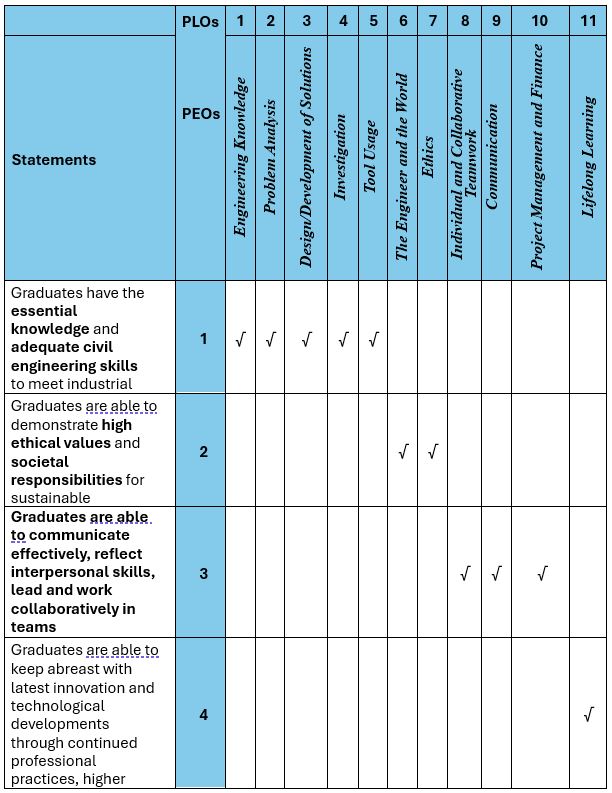
Program Educational Objectives
Following are the Program Educational Objectives (PEO’s)
Educational objectives that are expected to be exhibited by the civil engineers after 3-5 years
of their graduation.
- PEO-1: Graduates have the essential knowledge and adequate civil engineering skills to meet industrial requirements.
- PEO-2: Graduates are able to demonstrate high ethical values and societal responsibilities for sustainable development.
- PEO-3: Graduates are able to communicate effectively, reflect interpersonal skills, lead and work collaboratively in teams.
- PEO-4: Graduates are able to keep abreast with latest innovation and technological developments through continued professional practices, higher studies and research.
Program Learning Outcomes
Graduate Attribute Profile (GAS)/ Program Learning Outcomes (PLO’s) effective for Batches Fall 2025/Spring 2026 onwards:
...
- PLO-1 Engineering Knowledge: Apply knowledge of mathematics, natural science, engineering fundamentals and Engineering specialization to the solution of complex engineering problems (WK1-WK4).
- PLO-2 Problem Analysis: Identify, formulate, conduct research literature, and analyze complex Engineering problems reaching substantiated conclusions using first principles of mathematics, natural sciences and engineering sciences (WK1-WK4).
- PLO-3 Design/Development of Solutions: An ability to design solutions for complex engineering problems and design systems, components or processes that meet specified needs with appropriate consideration for public health and safety, cultural, societal, and environmental considerations (WK-5).
- PLO-4 Investigation: Conduct investigation of complex Engineering problems using research-based knowledge and research methods, including design of experiments, analysis and interpretation of data, and synthesis of information to provide valid conclusions (WK-8).
- PLO-5 Tool Usage: Create, select and apply appropriate techniques, resources, and modern engineering and IT tools, including prediction and modeling, to complex Engineering problems, with an understanding of the limitations (WK-2 and WK-6).
- PLO-6 The Engineer and the World: Analyze and evaluate sustainable development impacts to society, the economy, sustainability, health and safety, legal frameworks, and the environment while solving complex engineering problems (WK-1, WK-5, and WK-7).
- PLO-7 Ethics: Apply ethical principles and commit to professional ethics and norms of engineering practice and adhere to relevant national and international laws. Demonstrate an understanding of the need for diversity and inclusion (WK-9).
- PLO-8 Individual and Collaborative Team Work: Function effectively as an individual, and as a member or leader in diverse and inclusive teams and in multi-disciplinary, face-to-face, remote and distributed settings (WK-9).
- PLO-9 Communication: Communicate effectively and inclusively on complex engineering activities with the engineering community and with society at large, such as being able to comprehend and write effective reports and design documentation, and make effective presentations, taking into account cultural, language, and learning differences (WK-1 and WK-9).
- PLO-10 Project Management and Finance: Demonstrate knowledge and understanding of engineering management principles and economic decision-making and apply these to one’s own work, as a member and leader in a team, to manage projects in multidisciplinary environments (WK-2 and WK-5).
- PLO-11 Lifelong Learning: Recognize the need for, and have the preparation and ability for i) independent and life-long learning ii) adaptability to new and emerging technologies and iii) critical thinking in the broadest context of technological change (WK-8 and WK-9).
Read more
Program Schema
Scheme of Studies for BS Civil Engineering is a 4-years (8-semesters) Programme in which students are required to complete a specified number of courses:
Effective from FALL-2025/ Spring 2026 and Onwards
|
1st Year
|
|
First Semester
|
|
S. No.
|
Course Title
|
(Credit Hours)
|
Total Cr.
Hrs.
|
|
Theory
|
Lab
|
|
1
|
Civil Engineering Materials
|
2
|
1
|
3
|
|
2
|
Electrical Fundamentals
|
1
|
0
|
1
|
|
3
|
Mechanical Fundamentals
|
1
|
1
|
2
|
|
4
|
Engineering Drawing
|
1
|
2
|
3
|
|
5
|
Functional English
|
3
|
0
|
3
|
|
6
|
Quantitative Reasoning-I
|
3
|
0
|
3
|
|
7
|
Applications of ICT
|
2
|
1
|
3
|
|
Total
|
13
|
5
|
18
|
|
|
|
Second Semester
|
|
S. No.
|
Course Title
|
(Credit Hours)
|
Total Cr.
Hrs.
|
|
Theory
|
Lab
|
|
1
|
Engineering Surveying
|
2
|
1
|
3
|
|
2
|
Geology for Engineers
|
2
|
0
|
2
|
|
3
|
Islamic Studies/ Ethics
|
2
|
0
|
2
|
|
4
|
Engineering Mechanics
|
2
|
1
|
3
|
|
5
|
Ideology and Constitution of Pakistan
|
2
|
0
|
2
|
|
6
|
Computer Programming
|
2
|
1
|
3
|
|
7
|
Quantitative Reasoning-II
|
3
|
0
|
3
|
|
Total
|
15
|
3
|
18
|
|
2nd Year
|
|
Third Semester
|
|
S. No.
|
Course Title
|
(Credit Hours)
|
Total Cr.
Hrs.
|
|
Theory
|
Lab
|
|
1
|
Civil Engg. Drawing & Graphics
|
1
|
2
|
3
|
|
2
|
Advanced Engineering Surveying
|
2
|
1
|
3
|
|
3
|
Fluid Mechanics
|
2
|
1
|
3
|
|
4
|
Mechanics of Solids-I
|
2
|
1
|
3
|
|
5
|
Structural Analysis-I
|
3
|
0
|
3
|
|
6
|
Advanced Calculus
|
3
|
0
|
3
|
|
Total
|
13
|
5
|
18
|
|
|
|
Fourth Semester
|
|
S. No.
|
Course Title
|
(Credit Hours)
|
Total Cr.
Hrs.
|
|
Theory
|
Lab
|
|
1
|
Construction Engineering
|
2
|
0
|
2
|
|
2
|
Highway & Traffic Engineering
|
2
|
0
|
2
|
|
3
|
Applied Mathematics
|
3
|
0
|
3
|
|
4
|
Mechanics of Solids-II
|
2
|
1
|
3
|
|
5
|
Soil Mechanics
|
2
|
1
|
3
|
|
6
|
Pakistan Studies
|
2
|
0
|
2
|
|
7
|
Quantity & Cost Estimation
|
2
|
1
|
3
|
|
Total
|
15
|
3
|
18
|
|
3rd Year
|
|
Fifth Semester
|
|
S. No.
|
Course Title
|
(Credit Hours)
|
Total Cr.
Hrs.
|
|
Theory
|
Lab
|
|
1
|
Numerical Analysis
|
3
|
0
|
3
|
|
2
|
Pavement Analysis & design
|
2
|
1
|
3
|
|
3
|
Expository Writing
|
3
|
0
|
3
|
|
4
|
Geotechnical Engineering
|
3
|
1
|
4
|
|
5
|
Reinforced Concrete Design-I
|
3
|
1
|
4
|
|
Total
|
14
|
3
|
17
|
|
|
|
Sixth Semester
|
|
S. No.
|
Course Title
|
(Credit Hours)
|
Total Cr.
Hrs.
|
|
Theory
|
Lab
|
|
1
|
Hydraulics Engineering
|
2
|
1
|
3
|
|
2
|
Environmental Engineering
|
2
|
1
|
3
|
|
3
|
Structural Analysis-II
|
3
|
0
|
3
|
|
4
|
Advanced Fluid Mechanics
|
2
|
1
|
3
|
|
5
|
Runway, Railway and Ports Engineering
|
2
|
0
|
2
|
|
6
|
Civics and Community Engagement
|
2
|
0
|
2
|
|
7
|
Engineering Economics
|
2
|
0
|
2
|
|
Total
|
13
|
3
|
18
|
|
4th Year
|
|
Seven Semester
|
|
S. No.
|
Course Title
|
(Credit Hours)
|
Total Cr.
Hrs.
|
|
Theory
|
Lab
|
|
1
|
Foundation Engineering
|
2
|
0
|
2
|
|
2
|
Engineering Hydrology
|
2
|
1
|
3
|
|
3
|
Modelling & Simulation
|
1
|
1
|
2
|
|
4
|
Reinforced Concrete Design-II
|
3
|
1
|
3
|
|
5
|
Project Management
|
2
|
0
|
2
|
|
6
|
FYDP Part-I
|
0
|
3
|
3
|
|
7
|
Fahm-e-Quran I
|
1
|
0
|
0
|
|
Total
|
11
|
6
|
17
|
|
|
|
Eight Semester
|
|
S. No.
|
Course Title
|
(Credit Hours)
|
Total Cr.
Hrs.
|
|
Theory
|
Lab
|
|
1
|
Irrigation Engineering
|
2
|
1
|
3
|
|
2
|
Geoinformatics
|
1
|
1
|
2
|
|
3
|
Steel Structures
|
2
|
0
|
2
|
|
4
|
Architecture & Town Planning
|
2
|
0
|
2
|
|
5
|
Occupational Health & Safety
|
1
|
0
|
1
|
|
6
|
Professional Ethics
|
2
|
0
|
2
|
|
7
|
FYDP Part-II
|
0
|
3
|
3
|
|
8
|
Fahm-e-Quran II
|
1
|
0
|
1
|
|
Total
|
11
|
5
|
16
|
Admission Requirement
- 16 years of education or equivalent e.g. B.E/BS -
4 years in Civil Engineering from HEC recognized University with at least 60 % marks (annual system) or CGPA 2.5 out of 4.
- GAT General with at least 50% marks.
Degree Requirement
- Total Credit Hours: 30
- Total Courses:8
- Minimum CGPA ≥ 2.5
- Academic rules
* For details Program Schema